
A.I.

Skills
Tools & building
Prototyping
Vibe-Coding
Prompt Engineering
Figma + MCP
AI Systems
File Management
Command creation
Skill creation
Obsidian
Agents
Claude Code
Second Brain
Manus
My Claw
Research
Analytics Agent
Moderated UXR
Competitive analysis
Tools & building
Orchard
Cursor
VSCode
Claude Code

I don't prompt A.I. I've trained it to think with me.
Design Partner
Different A.I. personas: I built different A.I personas for different jobs calibrated for varying levels of scope and depth. The more targeted it is, the faster it’s intelligence grows.
Challenge me: AI natively agrees with you unless you train it not to. I trained mine to challenge my decisions, interrogate assumptions, and push back with context and constraints.
Constraint-based ideation: Rather than open-ended brainstorming, I feed A.I. tight constraints — platform rules, design principles, technical limitations — and generating solutions that are more buildable from the start.
Stress-test: I prompt A.I. to play the role of our sharpest design leads, or a first-time user to stress-test designs before real reviews. It surfaces objections early and sharpens the rationale.
Data Fetching
Data is no longer gated behind a data scientist. Using Analytics Agent with custom-built recipes I pulled integral data from IG and Messenger and applied their learnings to a similar feature on WhatsApp.
Prioritization
A million things are swirling at once. Prioritization and time-boxing are key to success.
A simple daily command that builds continuous context on all my projects outputs a daily prioritization briefing of what needs a decision, a response, approval and the best next steps on my projects.
Autonomous Replies
Time answering comments in specs, reviews, and escalations, compound quickly. I use an AI skill I trained to sound like me to draft responses that are informed from accessing my file system and I approve before responding.
Expedite Alignment
Alignment is still the most time-consuming aspect of the design process. I use AI-powered eval frameworks to compress it — synthesizing tradeoffs, risks, and scalability considerations into structured, shareable artifacts that move leadership and XFN to decision-making.
Prototyping & Vibecoding
The traditional design process is dead. It’s prototype and internal test first, align after. I am fluent in conceptual prototyping and brought many ideas to the AI Lab where I got leadership feedback and the green light. No PD, no Eng.
Swim lanes are merging. I'm shipping design and content changes directly — engineering is the reviewer, not the bottleneck.

Projects
Messaging brain @ WhatsApp

AI tools are only as good as the context they hold. Claude was good at understanding me and how I work — but it lacked tailored knowledge of WhatsApp, and specifically Design at Messaging. Every task required exhaustive context building: core flows, UI patterns, design principles, content constraints. The overhead was constant and the output was shallow.
So I helped fix that. This initiative was my idea.
In partnership with a product designer, I co-engineered a Claude skill — a persistent, trainable context layer that transforms Claude from a general-purpose AI into an experienced WhatsApp design collaborator and critique engine.
We trained the Messaging Brain on:
4 weeks of live Content & Messaging crit feedback
20+ core WhatsApp flows via a Figma MCP integration
10+ content design guidelines and messaging frameworks
PD messaging library, guidelines, and design principles, ethos
The output
A skill that could act as a 1,000-day WhatsApp user and messaging design critic vs a first-time user— giving feedback rooted in systems thinking, platform constraints, and established principles rather than generic UX heuristics.
The tool was adopted broadly across XFN. Designers, PMs, and cross-functional partners prompt the skill directly to standardize design review, pressure-test flows, and get a crit that actually knows the product.
AX standardization in system messages
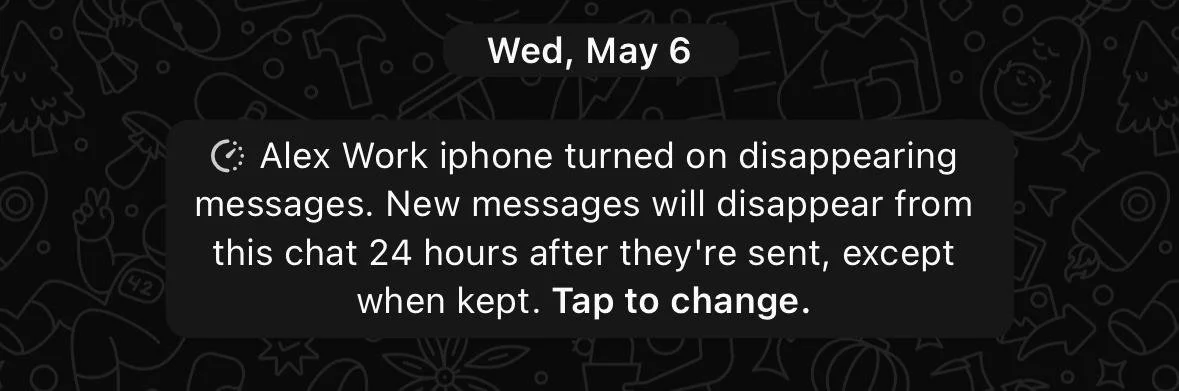

System messages are the connective tissue of WhatsApp groups — they are WA generated messages that communicate permission changes, membership updates, and critical group actions to billions of users. They hadn't been meaningfully updated in years, and weren't accessibility compliant.
As an off the roadmap project, I spearheaded this quality initiative end-to-end that eliminating "Tap to" CTA language that excludes users who interact with WhatsApp via assistive technologies
Using Claude Code, I cross-referenced and audited 4 codebases to identify non-compliant strings. I categorized changes by impact and type, then used a stacking method to batch and sequence diffs in a way that made engineering review faster.
The result: 40+ CTA string changes landed across codebases, with engineering as the reviewer. Previously this would have had to been coded and validated with eng.